
July 19, 2026
South African Pinot Noir: The Hemel-en-Aarde Story
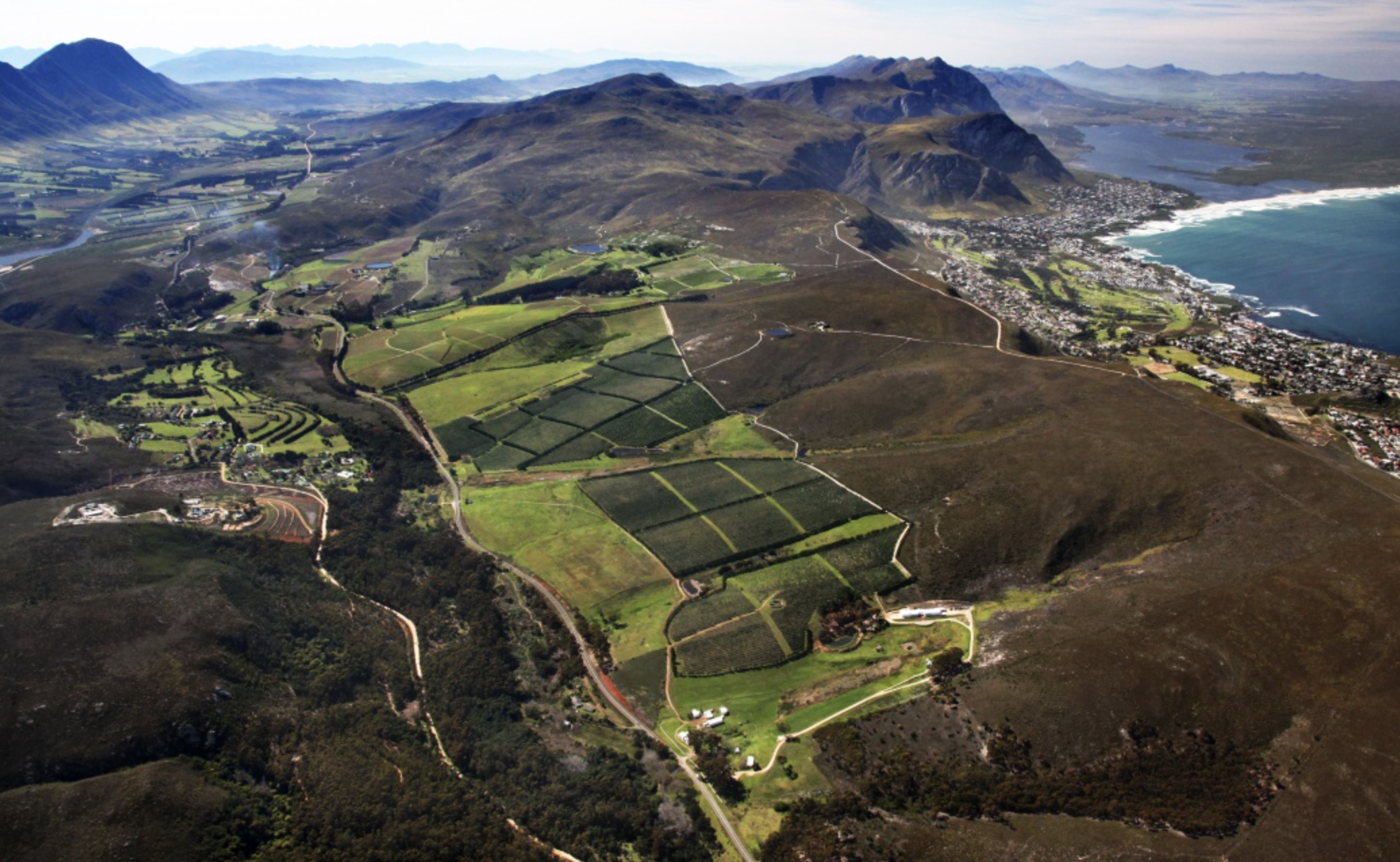
In 1975, Tim Hamilton Russell planted Pinot Noir on the slopes above Walker Bay near Hermanus, in a valley that nobody in the South African wine establishment was paying attention to. The location was considered marginal, the climate too cool, the distance from the established wine regions of Stellenbosch and Paarl too great. Pinot Noir was not considered a serious variety for the Cape. It required conditions that South Africa, with its warm Mediterranean climate and its tradition of robust red wines, was presumed unable to provide.
Fifty years later, the Hemel-en-Aarde Valley is recognised as one of the most important Pinot Noir appellations in the southern hemisphere, and Hamilton Russell Vineyards is regarded as one of the most historically significant and consistently excellent estates in the country. The conviction Tim Hamilton Russell acted on in 1975, that Walker Bay's maritime climate and the valley's ancient Bokkeveld shale soils could produce Pinot Noir of Burgundian character, has been comprehensively vindicated. And the story he started is now told not by one estate but by four, spread across three distinct wards within the broader Hemel-en-Aarde appellation, each producing Pinot Noir of genuine individual character and critical significance.
What Makes the Hemel-en-Aarde Valley Special
The Hemel-en-Aarde Valley's name translates from Afrikaans as Heaven and Earth, and the setting provides a partial explanation for the name: the valley is enclosed by the Kleinrivier Mountains to the north and opens southward toward Walker Bay, giving the vineyards a combination of mountain protection and direct oceanic exposure that creates one of the most distinctive growing environments in the Cape.
The cold Benguela current, which flows northward along the South African coast from the Antarctic, is the defining climatic influence. It moderates temperatures throughout the growing season, creating a mean summer temperature that is significantly cooler than Stellenbosch or the Swartland and providing the natural freshness and acidity that Pinot Noir requires for elegance and structural completeness. In warmer conditions, Pinot Noir produces wines of excessive weight and insufficient freshness. In the Hemel-en-Aarde, the maritime cooling creates a growing season of natural balance that the variety responds to with aromatic precision and structural definition.
The soils are ancient Bokkeveld shale, formed from marine sediments of the Devonian period approximately 380 million years ago. These dark, fine-grained soils are mineral-rich, well-drained on the valley's sloping vineyard sites, and of sufficient depth for vine root systems to engage deeply with the geological substrate. The mineral character they contribute to the wines is specific and immediately recognisable: a saline, almost marine quality that reflects the ocean floor origins of the rock and that distinguishes Hemel-en-Aarde Pinot Noir from expressions of the variety grown on granite or limestone elsewhere.
The Three Wards
What makes the Hemel-en-Aarde Valley particularly interesting for collectors is that it is not a single uniform terroir but three distinct wards, each with different characteristics shaped by elevation, aspect and the interplay of ocean influence and mountain protection. The three wards produce wines of meaningfully different character from the same variety in the same general climate, offering collectors a comparative survey of terroir expression within a single appellation.
Hemel-en-Aarde Valley
The original and lowest ward, most directly influenced by the Walker Bay maritime air and the Bokkeveld shale soils at their most characteristic. Hamilton Russell Vineyards and Bouchard Finlayson are the essential estates.
At this elevation and in this direct maritime exposure, the wines tend toward the most restrained and mineral of the three wards. The Hamilton Russell Pinot Noir is the benchmark: austere and precise in youth, with red cherry, earth and a mineral depth that develops gradually over eight to fifteen years of careful cellaring into a wine of considerable aromatic complexity and structural completeness. It does not flatter early. It rewards patience absolutely.
Bouchard Finlayson's Galpin Peak and Tête de Cuvée Pinot Noirs share the lower valley's maritime character but tend toward a somewhat more textural and immediately approachable style, informed by the Burgundian heritage of the estate's co-founder Paul Bouchard. The Tête de Cuvée rewards eight to fifteen years.
Hemel-en-Aarde Ridge
The middle ward, at higher elevation on the western slopes above the valley floor, where soils combine Bokkeveld shale with sandstone and the microclimate is somewhat warmer in the day and cooler in the evenings than the lower valley. Crystallum, under Peter-Allan Finlayson, is the essential Ridge producer.
The Ridge position produces wines of greater textural richness and aromatic complexity than the lower valley floor, with more generous red fruit character and a slightly broader palate weight that makes the wines more immediately engaging in youth while maintaining the structural integrity to develop over eight to fifteen years. The Peter Max Pinot Noir from Crystallum combines whole-cluster fermentation's characteristic aromatic lift and silky texture with the Ridge's natural generosity, producing one of the most critically admired and collector-sought Pinot Noirs in South Africa.
Upper Hemel-en-Aarde Valley
The highest and most inland ward, with the greatest diurnal temperature range of the three and the most continental character. Direct maritime influence from Walker Bay is reduced by the distance and the intervening ridgeline, replaced by cold air draining from the mountains at night that preserves natural acidity and aromatic freshness whilst warmer days allow fruit to develop concentration.
Restless River under Craig Wessels is the essential Upper ward producer, making Pinot Noir of exceptional structural austerity and mineral tension that demands the most patience of the three wards' expressions. In youth the Upper ward wines are lean and demanding, their complexity locked behind tannin and mineral structure. With ten or more years of careful cellaring they develop a depth and aromatic completeness that rewards the collector who understood what they were buying from the outset.
Bokkeveld Shale and What It Does to Pinot Noir
The Bokkeveld shale that underlies all three wards is the geological thread that connects them and gives the Hemel-en-Aarde Valley its specific and immediately recognisable wine character. Understanding what this ancient rock does to Pinot Noir is essential to understanding why this appellation produces wines unlike those from any other major Pinot Noir-producing region.
Bokkeveld shale is a dark, fine-grained sedimentary rock of marine origin, formed from the compressed sediments of an ancient sea floor during the Devonian period, approximately 380 million years ago. It is mineral-rich, with a specific chemical composition that differs significantly from the limestone soils of Burgundy, the granitic soils of the Willamette Valley or the basaltic soils of Central Otago.
The specific mineral character of Bokkeveld shale manifests in the wines as a saline, almost marine quality on the finish, a directness of mineral expression that is immediately distinctive and that experienced tasters consistently identify in Hemel-en-Aarde wines regardless of which ward they come from. It is not the chalky, calcium-driven mineral of Burgundy or the volcanic mineral of certain Central Otago sites. It is something specific to this ancient rock, in this specific oceanic position, and it is one of the most compelling arguments for the Hemel-en-Aarde Valley as a genuinely irreplaceable Pinot Noir terroir.
The shale's water-retention properties, combined with the valley's reliable annual rainfall pattern, provide the vine roots with consistent moisture access through the growing season without the need for irrigation. The deep root systems that develop over decades of dry-land or near-dry-land farming in these conditions produce fruit of natural concentration and mineral complexity that the vine communicates directly to the wine.
The Walker Bay Maritime Influence
The Benguela current's effect on the Hemel-en-Aarde Valley is worth examining in detail because it is the climatic factor that makes the appellation suitable for world-class Pinot Noir rather than simply for competent Mediterranean-climate red wine.
The current flows at a surface temperature of between 8 and 12 degrees Celsius along the south-western coast of Africa, making it one of the coldest ocean currents in the world. As it passes Walker Bay, it cools the air above it, which then flows inland through the valley on the afternoon sea breezes that are a daily feature of the growing season. These afternoon breezes reduce daytime temperatures by several degrees from what the ambient sun-driven warmth would otherwise produce, creating a diurnal temperature range that preserves natural acidity and aromatic compounds in the fruit.
The same maritime influence that would make Pinot Noir impossible in Stellenbosch, where the ocean is more distant and less influential, makes it possible in the Hemel-en-Aarde Valley, where the proximity to Walker Bay and the valley's south-facing orientation maximise the cooling effect. This is not a marginal influence. It is the fundamental climatic fact that allows Pinot Noir to ripen to physiological maturity in the Hemel-en-Aarde Valley while retaining the natural freshness and aromatic precision that the variety requires.
The Essential Producers
Hamilton Russell Vineyards
The pioneer and benchmark. Fifty years of Hemel-en-Aarde Valley Pinot Noir under consistent philosophical stewardship, producing the most historically significant and reliably excellent expression of the variety in South Africa. Essential for any serious South African cellar.
Crystallum
Peter-Allan Finlayson's most celebrated wine and one of the most critically admired Pinot Noirs in the Cape. Peter Max Pinot Noir combines whole-cluster fermentation's aromatic lift with the Hemel-en-Aarde Ridge's natural generosity, developing over eight to fifteen years into a wine of considerable complexity.
Bouchard Finlayson
Burgundian heritage and three decades of lower valley experience produce the Galpin Peak and Tête de Cuvée, wines of consistent quality and approachable style that provide an excellent entry point to the Hemel-en-Aarde Valley appellation.
Restless River
The most demanding and most individual expression of Hemel-en-Aarde Pinot Noir, from the highest and most austere Upper ward. Tiny production, exceptional mineral tension, rewards the most patient collectors most fully.
Comparing Hemel-en-Aarde Valley with Burgundy
The comparison with Burgundy is inevitable and, within its limits, useful. The Hemel-en-Aarde Valley produces Pinot Noir that shares the same basic stylistic orientation as Burgundy: aromatic precision, mineral-driven character, structural elegance rather than weight, age-worthy rather than immediately impressive. The varieties grown, the general winemaking philosophy and the basic climatic requirements are all comparable.
The geological difference is significant, however, and produces wines that are genuinely distinct from Burgundy rather than southern hemisphere approximations of it. The Bokkeveld shale mineral character has no direct equivalent in Burgundy's limestone-dominated geology. The Walker Bay marine influence, more intense and direct than any river valley cooling effect in the Cote d'Or, creates a different kind of freshness in the wines. The finest Hemel-en-Aarde Pinot Noirs are not trying to be Burgundy. They are expressing the specific character of their own terroir, and the most interesting and rewarding way to engage with them is to understand them on those terms.
The Collector Opportunity
The pricing of Hamilton Russell Vineyards, Crystallum, Bouchard Finlayson and Restless River Pinot Noir bears no relationship to what wines of equivalent critical recognition and ageing potential from Burgundy would command. This is a function of the Hemel-en-Aarde Valley's still-developing international profile rather than any deficiency in the wines themselves. The gap will narrow as recognition grows. It represents a genuine opportunity for collectors who understand what they are buying before the broader market does.
Explore the Hemel-en-Aarde Valley
Buy Hemel-en-Aarde Valley Wine