
July 8, 2024
Champagne Regions Explained: A Complete Guide (2025)
Category: Champagne, Fine Wine
Champagne is not a single place but a collection of distinct sub-regions, each with its own soils, microclimates, dominant grape varieties, and resulting wine character. The diversity within the appellation is far greater than the name on the label suggests. Understanding these sub-regions is the most practical way to decode why one Champagne feels powerful and structured while another is all elegance and mineral precision — and to make more informed decisions about which houses and styles suit you best.
Montagne de Reims
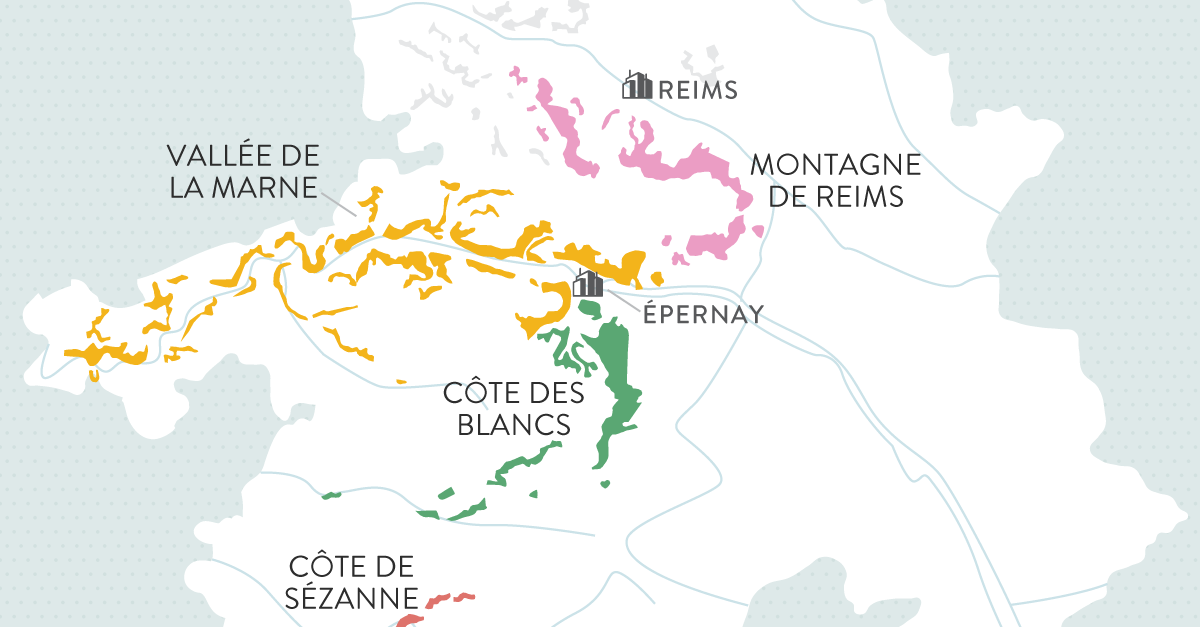
The Montagne de Reims is a forested plateau south of Reims, with vineyards planted on the north- and east-facing slopes of the mountain and on the warmer south-facing sites in the Grande Montagne. The soils are predominantly chalk, providing the excellent drainage and minerality that characterise great Champagne terroir. Pinot Noir is the dominant grape here, thriving in a microclimate shaped by the forest's moderating influence and producing wines of notable body, structure, and dark fruit intensity.
The great houses of Montagne de Reims include Krug, known for the richness and complexity of its blends, and Bollinger, whose Pinot Noir-dominant style delivers the full-bodied, robust character associated with the region. Veuve Clicquot also draws significantly on Montagne fruit for the structure of its Yellow Label. The sub-region is home to a number of the most celebrated Grand Cru villages, including Ambonnay, Bouzy, and Verzenay.
Vallée de la Marne
The Vallée de la Marne stretches along the Marne River west of Épernay, with vineyards planted on steep slopes that benefit from the reflective light off the river and from the relatively warm, sheltered conditions in the valley. The soils here are a mix of clay, sand, and limestone — heavier than the chalk of the Montagne and Côte des Blancs, which suits Pinot Meunier well. Meunier is the dominant variety of the Vallée, and its contribution to blends — roundness, fruitiness, and early approachability — is closely associated with the region's character.
Moët & Chandon sources extensively from the Vallée, and the resulting wines show the generous, fruit-forward style that has made the house's Impérial non-vintage the world's best-selling Champagne. Billecart-Salmon, celebrated for its delicate Rosé, and Perrier-Jouët, known for its floral, refined character, also draw on Marne fruit. The Vallée is less associated with prestige cuvées than the other sub-regions but plays an essential role in giving most great Champagne blends their early charm.
Côte des Blancs
South of Épernay, the Côte des Blancs is Champagne's spiritual home for Chardonnay. The name translates literally to "slope of the whites," and the pure chalk soils here are among the finest in the world for producing Chardonnay of exceptional finesse, mineral precision, and longevity. The wines from this region are characterised by their crisp acidity, citrus and floral aromatics, and — particularly from the Grand Cru villages of Cramant, Avize, Le Mesnil-sur-Oger, and Oger — a mineral intensity that can be almost electric.
Blanc de Blancs Champagnes — made exclusively from Chardonnay — find their highest expression here. Dom Pérignon, which blends significantly more Chardonnay than most prestige cuvées, draws much of its elegance and longevity from Côte des Blancs fruit. Salon, the ultra-rarified single-vineyard Blanc de Blancs from Le Mesnil, and Taittinger's Comtes de Champagne are among the most celebrated expressions of what this sub-region can achieve at its finest.
Côte de Sézanne
The Côte de Sézanne lies south of the Côte des Blancs and shares many of its characteristics — chalky soils, Chardonnay dominance — though the slightly warmer climate encourages earlier ripening and produces wines with a little more roundness and generosity than the pure mineral precision of the Côte des Blancs. It is a less celebrated but genuinely interesting sub-region, with a small number of quality-focused producers working with excellent raw material at prices that reflect the region's relatively lower profile.
Charles Heidsieck draws on Sézanne fruit for some of the complexity in its blends. Larmandier-Bernier, one of the most respected grower-producers in the region, works biodynamically and produces wines of remarkable terroir expression.
Aube (Côte des Bar)
The Aube is the southernmost part of the Champagne appellation, separated from the other sub-regions by a significant geographic gap. Its soils are Kimmeridgian marl — the same limestone-clay mix found in Chablis and Sancerre — rather than the pure chalk of the northern zones. Pinot Noir dominates, producing wines with a richer, earthier, and more fruit-forward character than the Montagne de Reims, often with a distinctive rustic charm. The Aube has historically supplied significant quantities of fruit to the major houses but is increasingly recognised for producing genuine single-village and single-vineyard wines of character.
Drappier is the most prominent Aube house, known for its bold, Pinot Noir-driven Champagnes. Grower producers like Jacques Lassaigne have also attracted significant critical attention for wines that explore the sub-region's terroir in ways that the large houses historically did not.
Browse Champagne
View all available Champagne → | Browse Dom Pérignon → | Browse Krug →
Related Reading
Grande Marques Champagne houses explained | How Champagne is made | Top Champagne vintage years