
Bordeaux First Growths: The Complete Guide
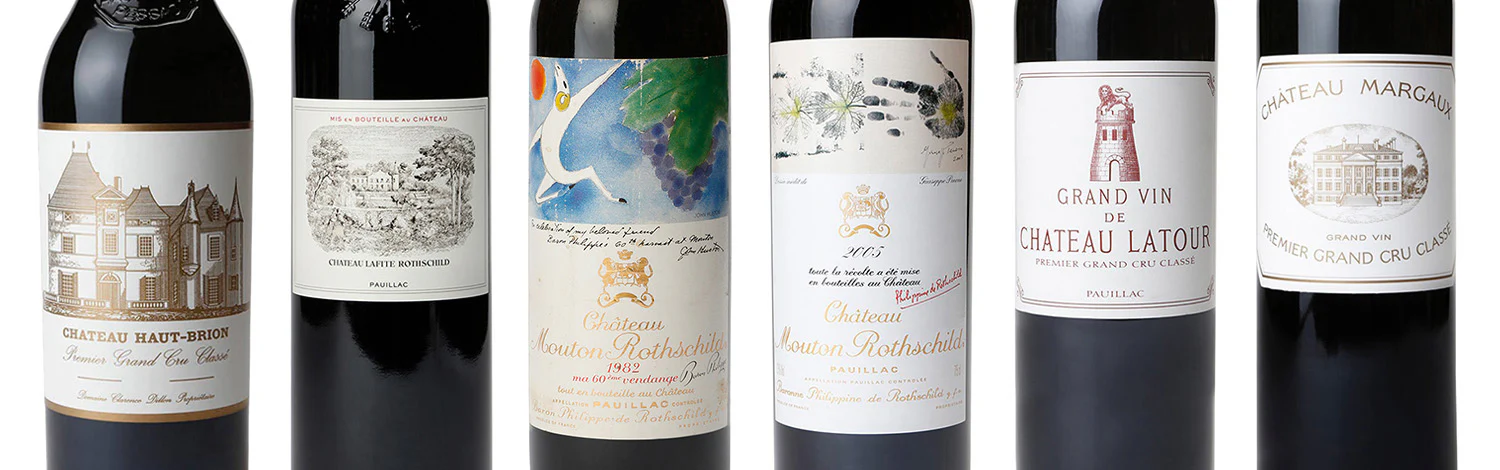
What Are the Bordeaux First Growths?
The Bordeaux First Growths — Premier Crus Classés — are the five estates that sit at the very top of the 1855 Classification. They are Chateau Lafite Rothschild, Chateau Latour, Chateau Mouton Rothschild, Chateau Margaux, and Chateau Haut-Brion.
In nearly two centuries, only one change has been made to the original classification: in 1973, Chateau Mouton Rothschild was elevated from Second Growth to First Growth — the only reclassification in the entire history of the 1855 system.
These are not simply prestigious labels. The First Growths represent estates where extraordinary terroir, long institutional investment, and consistent winemaking have converged across generations to produce wines that age for decades, trade actively on the secondary market, and form the cornerstone of serious Bordeaux collections.
The 1855 Classification: Why It Still Matters
The classification was commissioned by Napoleon III for the Paris World Exhibition, ranking Bordeaux wines by their trading price — itself a proxy for quality and reputation. The estates ranked in 1855 were, by and large, those that had already proven their value across decades.
What makes it remarkable is not that the classification was created, but that it has proven so durable. With one exception, the five First Growths named in 1855 are the same five that dominate auction results, secondary market prices, and collector conversations today. That kind of continuity across 170 years is not coincidence — it reflects the underlying reality of the terroir.
For collectors, the 1855 Classification remains the primary framework for understanding Bordeaux wine hierarchy, and the First Growths represent its peak.
The Five Bordeaux First Growths
Chateau Lafite Rothschild — Pauillac
The most refined and aromatic of the five. Lafite is defined by precision, length, and an extraordinary capacity to evolve — revealing layers of cassis, cedar, graphite, and subtle florals over decades. It has been under Rothschild family ownership since 1868 and is among the most actively traded fine wines in the world. Key vintages include 1982, 1996, 2000, 2005, 2009, 2010, and 2016.
Explore Chateau Lafite Rothschild →
Chateau Latour — Pauillac
The most structured and long-lived of the First Growths. Latour is built on the Enclos, a 47-hectare vineyard at the southern tip of Pauillac whose deep gravel soils produce wines of extraordinary tension and longevity. In 2012, Latour withdrew from the En Primeur system, releasing wines only when the estate judges them ready — a decision that has reinforced both its provenance and its secondary market value. Key vintages include 1996, 2000, 2010, 2016, and 2019.
Chateau Mouton Rothschild — Pauillac
The boldest and most opulent of the Pauillac First Growths, and the one with the most distinctive cultural identity. Mouton's label art tradition — commissioning a different artist for each vintage since 1945, from Picasso to Francis Bacon to Jeff Koons — makes it the most recognisable wine in the world to audiences beyond collectors. Winemaking emphasises richness and concentration, with 100 percent new oak producing wines that are powerful in youth but develop considerable complexity with age. Key vintages include 1945, 1986, 2000, 2009, 2010, and 2016.
Explore Chateau Mouton Rothschild →
Chateau Margaux — Margaux
The only First Growth from the Margaux appellation, and the most elegant of the five. Where Pauillac's First Growths are built on power, Margaux is defined by perfume, silky tannin structure, and a distinctive floral lift — the expression of its thin, gravelly soils over clay and limestone. The estate's neoclassical château, often called the "Versailles of the Médoc," is as iconic as the wine. Under Corinne Mentzelopoulos, who has led the estate since 1980, Margaux has reached a level of consistent quality that few properties anywhere can match. Key vintages include 1990, 2000, 2005, 2009, 2010, 2015, and 2016.
Chateau Haut-Brion — Pessac-Léognan
The outlier of the five, and in many ways the most fascinating. While the other First Growths cluster within the Médoc, Haut-Brion sits in Pessac-Léognan on the outskirts of Bordeaux city — the only non-Médoc estate included in the 1855 Classification, admitted because its reputation at the time was simply too significant to ignore. The wine is unlike anything else among the First Growths: a smoky, earthy, mineral-driven expression of Cabernet Sauvignon and Merlot that evolves into extraordinary complexity. Haut-Brion also produces one of the finest dry white wines in Bordeaux, Haut-Brion Blanc, which is among the most sought-after white Bordeaux in the world. Key vintages include 1989, 1990, 2000, 2009, 2015, 2016, and 2019.
Which Bordeaux First Growth Should You Buy?
The answer depends on what you are looking for in a cellar.
If you value finesse and aromatic precision, Lafite Rothschild is the natural starting point. If you want the wine with the greatest proven long-term cellaring potential, Latour is the answer. If cultural cachet and opulence appeal — or if you want a wine that non-collectors immediately recognise — Mouton Rothschild stands apart. For elegance and drinkability at a relatively earlier window, Margaux is compelling. And if you want the wine that surprises even seasoned collectors — something that offers a completely different flavour profile from the Médoc — Haut-Brion is unlike anything else at this level.
All five are sound investments for long-term collectors. All five have strong secondary market liquidity. The right question is not which is best — it is which aligns with how you cellar and what you want to drink.
Buying First Growths En Primeur
Four of the five First Growths — Lafite, Mouton, Margaux, and Haut-Brion — are still released through the Bordeaux En Primeur system, typically around eighteen months after harvest. Buying en primeur gives you access to the widest range of case formats and the best opening prices, though wines will not be bottled and ready for delivery for several years.
Chateau Latour is the exception. Since 2012, it has released wines outside the en primeur system, with bottles going to market only when the estate judges them ready — typically ten to fifteen years after harvest.
Fine Wine Library holds direct allocations through La Place de Bordeaux, giving us access to all five First Growths across current and back vintages.
Browse all Bordeaux En Primeur →
Storage and Provenance
First Growth Bordeaux requires proper long-term storage to preserve condition and, critically, provenance. All wines purchased through Fine Wine Library are held In Bond, excise duty free, ensuring temperature-controlled conditions and a clean, unbroken ownership chain — which matters significantly when the time comes to drink or resell.
Learn more about wine storage →