
January 28, 2025
Bordeaux Wine Regions: Complete Guide to Every Appellation
Category: Bordeaux, Fine Wine
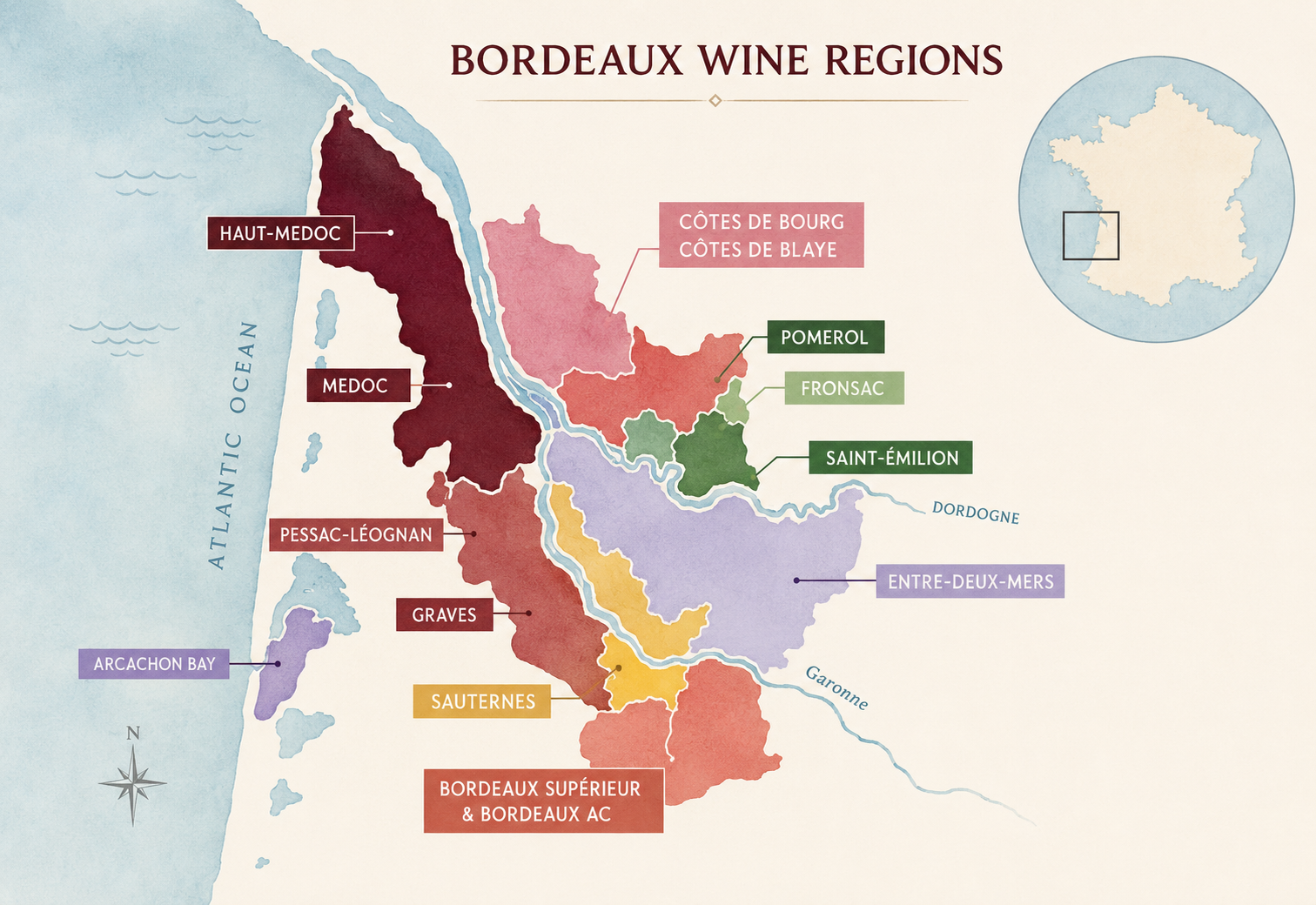
Bordeaux is one of the largest and most complex fine wine regions in the world, covering approximately 120,000 hectares of vineyards across southwestern France. Within that area, the diversity is extraordinary — from the powerful, tannic reds of the Médoc to the silky Merlot-dominant blends of Saint-Émilion and Pomerol, the mineral dry whites of Pessac-Léognan, and the luscious sweet wines of Sauternes. Understanding the key appellations and what makes each distinct is the foundation for making confident decisions about what to buy and when to drink it.
For a focused comparison of the Left Bank and Right Bank, see our dedicated article on Bordeaux Left Bank vs Right Bank.
The Left Bank: Médoc and Graves
The Left Bank runs along the western side of the Gironde estuary and the Garonne River. Its defining characteristic is the gravelly soil — deep beds of rounded pebbles that provide excellent drainage and retain heat, creating conditions ideally suited to Cabernet Sauvignon. The wines are typically blends led by Cabernet Sauvignon, with Merlot, Cabernet Franc, and Petit Verdot playing supporting roles. Left Bank reds are known for their structure, firm tannins, and ability to age for decades.
The Médoc contains Bordeaux's most famous appellations. Pauillac is home to three of the five First Growths — Chateau Lafite Rothschild, Chateau Latour, and Chateau Mouton Rothschild — and produces wines of exceptional concentration, graphite, and dark fruit with enormous longevity. Margaux is the most elegant of the Left Bank appellations, prized for its aromatic finesse and silky texture. Saint-Julien sits between the two in style — consistent, precise, and reliable across its classified estates. Saint-Estèphe tends toward the most structured and tannic of the Left Bank communes, with higher clay content in its soils lending the wines a more robust, long-lived character.
South of the Médoc, Pessac-Léognan is both the birthplace of Bordeaux winemaking and home to Chateau Haut-Brion — the only non-Médoc estate included in the 1855 Classification. The region produces outstanding reds and whites, the latter showing remarkable mineral complexity and often capable of ageing as impressively as the finest red Bordeaux.
The Right Bank: Saint-Émilion and Pomerol
The Right Bank, east of the Dordogne River, is defined by clay and limestone soils that suit Merlot far better than Cabernet Sauvignon. The wines are softer, rounder, and more approachable in their youth than their Left Bank counterparts, though the finest examples — particularly from Pomerol — age with every bit as much distinction.
Saint-Émilion is a UNESCO World Heritage Site and one of Bordeaux's most visited appellations, its medieval town surrounded by vineyards on limestone plateaus and clay slopes. The best wines show lush red and black fruit, velvety tannins, and a spice and floral complexity that reflects the diversity of soil types within the appellation. Chateau Cheval Blanc and Chateau Ausone are its most celebrated estates, each producing wines of extraordinary depth and reputation.
Pomerol is one of Bordeaux's smallest prestigious appellations — there is no formal classification, no grand château architecture, and production is tiny. What it produces, however, is some of the most sought-after wine in the world. The iron-rich clay of the plateau, centred on Chateau Petrus, imparts a richness, depth, and silky texture to its Merlot-dominant wines that is unique in Bordeaux. Petrus, Le Pin, and Lafleur regularly command prices that rival any wine produced anywhere.
Entre-Deux-Mers
Entre-Deux-Mers — literally "between two seas" — occupies the triangular zone between the Garonne and Dordogne rivers. The region is best known for its fresh, aromatic dry whites made from Sauvignon Blanc, Sémillon, and Muscadelle, which offer excellent value for everyday drinking with their citrus, herbal, and mineral character. Red wines produced here typically qualify under the broader Bordeaux AOC rather than the Entre-Deux-Mers appellation itself.
Sweet Wine Regions: Sauternes and Barsac
Bordeaux's sweet wine regions sit along the Garonne River south of the city, where the confluence of the Ciron and Garonne rivers creates the morning mists that encourage noble rot — the botrytis fungus that concentrates sugars and flavour in the grapes while preserving acidity. The result, when conditions align, is some of the greatest sweet wine in the world.
Sauternes and its sub-appellation Barsac produce wines made primarily from Sémillon, with Sauvignon Blanc and Muscadelle adding aromatic lift. The wines are characterised by honey, apricot, tropical fruit, and saffron, balanced by the acidity needed to prevent them from feeling heavy. Chateau d'Yquem, the only estate classified as Premier Cru Supérieur in 1855, stands alone at the peak — producing wines of extraordinary richness, precision, and ageing potential.
Lesser-Known Appellations
Bordeaux's reach extends well beyond the famous names. The Côtes de Bordeaux appellations — Blaye, Cadillac, Castillon, and Francs — produce predominantly Merlot-based reds that offer genuine quality at accessible prices, making them among the best-value options in the region for collectors seeking to explore beyond the classified estates. The broader Bordeaux AOC and Bordeaux Supérieur classifications cover the most widely produced wines, with Supérieur requiring slightly stricter production standards and typically representing a step up in quality.
Browse Bordeaux
See all available Bordeaux wines → | Browse Pauillac → | Browse Saint-Émilion → | Browse Pomerol →
Related Reading
Left Bank vs Right Bank | Bordeaux food pairing | How to store Bordeaux | Bordeaux 2009 and 2010