
April 6, 2026
How Bordeaux En Primeur Pricing Is Determined
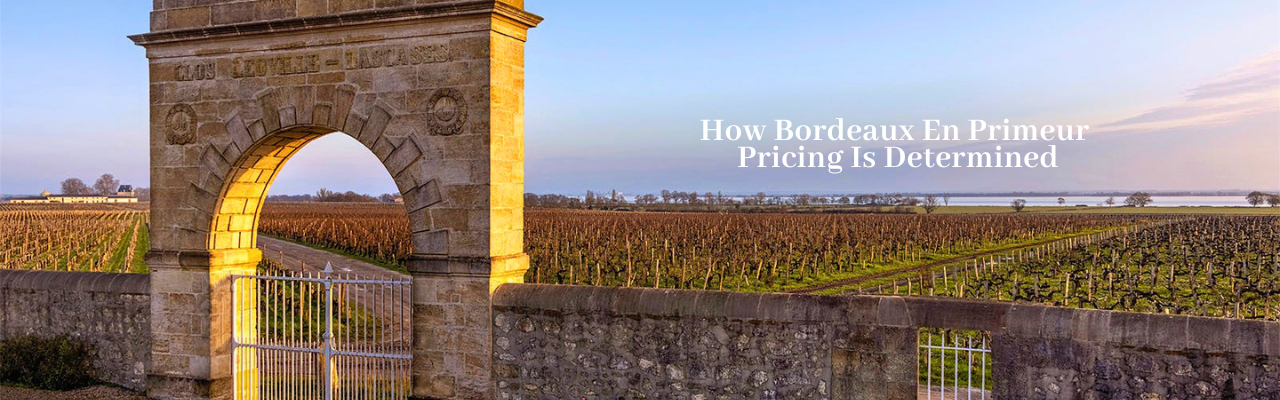
Every spring, as the Bordeaux campaign opens, the same question dominates collector conversations: Is this wine priced fairly?
It sounds simple. It isn't. En Primeur pricing is the result of several overlapping forces — vintage quality, market positioning, currency dynamics, critic influence, and commercial strategy — all operating simultaneously. Understanding how pricing works is the difference between buying with confidence and guessing.
The starting point: vintage quality at barrel tasting
Pricing begins in April, when merchants, critics and négociants taste the new vintage from barrel. At this stage the wines are unfinished — blending decisions may not yet be finalised — but their fundamental character is already legible to an experienced taster. Structure, tannin quality, acidity, fruit concentration and balance all reveal themselves clearly enough to make a reasonable assessment of quality and ageing potential.
This assessment forms the commercial foundation for the entire campaign. A vintage that shows exceptional precision and depth at barrel tasting will be positioned differently — and priced differently — than one that shows competent but unexciting fruit. The châteaux know what the trade has tasted. They know what the early critical reactions are. Pricing follows from there.
What this means in practice: the first releases of the campaign, which tend to come from the most prominent Right Bank estates, function almost as pricing signals for everything that follows. Where Pétrus, Cheval Blanc and Angélus open the campaign sets an expectation — and the Médoc First Growths subsequently price relative to that context.
How châteaux compare to back vintages
The single most important pricing variable — more than vintage quality itself — is how the new release compares to available back vintages of similar or higher quality.
Buyers are constantly running this calculation. If 2025 is being released at a price that makes 2019 look cheap on the secondary market, demand for 2025 will be selective. If 2025 is priced attractively relative to 2022 or 2023, it will move quickly. Châteaux understand this, and their commercial teams spend significant time modelling these comparisons before setting opening prices.
The 2019 vintage is the clearest recent illustration of this working well. Châteaux priced it realistically relative to 2018 — which had been well-received but felt expensive to some buyers — and the market responded with genuine enthusiasm. Demand was strong, allocations moved fast, and the vintage has appreciated meaningfully since bottling. The pricing decision reinforced the vintage's reputation rather than undermining it.
The 2022 vintage showed the opposite dynamic at the top end. Several First Growths and prominent Right Bank estates opened at prices that felt difficult to justify relative to 2019 and 2020 sitting on the secondary market. The market pushed back. Uptake was selective. Some wines were subsequently discounted through the négociant system. The lesson was noted — and visibly influenced how 2024 was approached, with meaningful price reductions across the top end.
The role of critic scores
Critic scores don't determine pricing — châteaux set prices before most scores are published — but they have an enormous influence on demand once prices are announced.
The mechanism works like this: a château releases at a given price, early critic scores land within days, and the market either validates or questions the pricing. A First Growth that releases at €500 per bottle and receives near-universal 98–100 point scores will sell immediately regardless of whether the price feels high. The same wine with scores in the low-to-mid 90s will face a much more critical reception.
This is why the major critical voices — Robert Parker's successors at Wine Advocate, James Suckling, Jancis Robinson, Neal Martin — publish their notes as quickly as possible after tasting week. Speed matters. Early high scores create momentum; early equivocal notes create hesitation. Châteaux track this carefully, and estates that consistently receive high critical praise have considerably more pricing flexibility than those with uneven track records.
For collectors, the practical implication is this: in a campaign where a wine receives exceptional scores, the window between release and sell-out can be very short. Waiting for a second or third opinion before committing is a reasonable strategy for wines with average critical reception. For the most decorated wines in a celebrated vintage, hesitation costs you the allocation.
Supply, scarcity and yield
Quantity available directly affects pricing power — but not always in the direction you might expect.
In low-yield vintages like 2025, where total Gironde production is estimated at around 15% below the five-year average, châteaux have a legitimate commercial argument for higher prices: there is simply less wine to sell. Whether they exercise that option is a separate question, and the market will determine whether it was wise.
The more nuanced version of this is appellation-level scarcity. Pomerol is always small. The Right Bank's top estates — Pétrus, Le Pin, Lafleur — produce quantities measured in hundreds of cases rather than thousands. For these wines, scarcity is a permanent condition rather than a vintage-specific one, which is why their pricing trajectory has been consistently upward over time regardless of campaign conditions.
On the Left Bank, where production volumes are larger, scarcity matters less at the château level and more at the allocation level. The question is not whether the wine exists — it's whether your merchant has an allocation, and how much of it is available to you.
Currency and global demand
Bordeaux prices are set in euros, but demand is global. Currency movements create real-time arbitrage opportunities that shape which markets are most active in any given campaign.
When the dollar or pound is strong relative to the euro, Bordeaux becomes more attractively priced for US and UK buyers, and demand from those markets rises. When Asian currencies are performing well, demand from Hong Kong, Singapore and mainland China increases. Châteaux are aware of these dynamics and factor them into timing and pricing decisions — there's little point releasing at a price point that feels expensive to your three largest buyer markets simultaneously.
The 2020 pandemic campaign, conducted remotely with critics tasting samples sent from Bordeaux, illustrated how global demand dynamics can support prices even in extraordinary circumstances. Buyers who had been locked down for months engaged actively with the campaign, demand was strong, and many wines performed better than expected given the context.
The négociant system and release tranches
Bordeaux doesn't release En Primeur all at once. The campaign runs over six to eight weeks in tranches, and the sequencing is deliberate.
Early releases — typically from prominent Right Bank estates and some Médoc second labels — test market appetite and establish a pricing reference point. If early releases sell strongly, subsequent châteaux gain confidence to hold or increase their pricing. If early releases are met with hesitation, later-releasing estates tend to be more conservative.
The négociant layer adds another dimension. Fine Wine Library buys through La Place de Bordeaux — the established system of Bordeaux négociants who act as intermediaries between châteaux and international merchants. Négociants take a margin, merchants take a margin, and the price you pay reflects both. The advantage of this system is transparency: La Place pricing is consistent across the market, and the provenance chain from château to bonded warehouse is clear and documented.
What "fair pricing" actually means
After all of this, how do you assess whether a wine is priced fairly?
The most reliable framework is comparative: how does this wine's release price compare to the same château's previous vintages, currently available on the secondary market? If 2025 Léoville-Las Cases is releasing at a price significantly above 2019 Léoville-Las Cases — a vintage with outstanding critical scores, now bottled and fully assessed — you need a compelling reason to prefer the futures. If it's releasing at a discount or at parity, the En Primeur proposition becomes much more interesting.
The second test is scarcity: will this wine be widely available after bottling, or does the estate produce in quantities that make it genuinely difficult to find? For wines with tight allocations and consistent demand — the Pomerol grands vins, certain Pessac-Léognan estates, the cult Right Bank producers — En Primeur pricing is almost always competitive with what you'll pay later, because "later" often means the secondary market at a significant premium.
The third test is quality relative to price tier. En Primeur is not only a First Growth game. Some of the most compelling value in any campaign comes from classified growths — Second, Third, Fourth, Fifth — that have outperformed their classification in a particular vintage but whose pricing hasn't caught up with their quality. The 2025 campaign, like every campaign, will have wines that punch significantly above their price point. Finding them is what separates opportunistic cellar building from simply collecting names.
Ready to buy Bordeaux 2025 En Primeur? Browse our current allocations →
New to En Primeur? Read our complete guide to how it works →